The Returns Desk
An endless counter where Librarians leave through their Doors and are checked back in.
Every world has a story. Find your place in the Library.
Every mission starts with a thin file from a case officer. Roll one to see the kind of job a new team gets handed. Your GM rolls the real one, with a few tables you don’t get to see.
One mission, three evenings. Live over Discord voice, three hours a night, four Librarians to a table. New to Daggerheart? We start with a short orientation.
Your arrival. Found or Sentenced, your trial or your waking, and your first Door.
The mission proper. Same table, same Librarian you built on night one.
Dice are rolled for you if you have none. Discord, a microphone, and an evening.
The Library seats adults: you must be 18 or older to book. Payment is taken at booking. Cancel more than 24 hours ahead for a full refund. A table opens with two or more Librarians; if yours doesn't fill, you are refunded in full. See the house rules.

Kadmoniy, Case Officer. The voice on the other side of every Door.
I'm Reuben. At the Library I'm Kadmoniy, the Case Officer, and the voice on the other side of every Door.
I've run tables for eight years, for friends and for strangers, online and across kitchen tables, and for the last year as a paid GM. Daggerheart has been my main game since the day it came out. Before and alongside it: D&D 5e, Mothership, The Wildsea, Legend in the Mist, Monster of the Week, Kids on Bikes, and Fate Core. The Library exists because I wanted a setting that could produce worlds and situations my players had never met before, and a place that grows as tables play in it. What your table does ends up in the stacks.
My style sits between story and tactics; I lean toward whatever the table is enjoying. I think there's a little humour in every serious moment and some drama at the height of silliness, and I run both. Players tell me they remember the characters and the lore of the worlds we visit. The moment I'd put on a poster is the one where you've made a plan, carried it out, and everything comes down to a few rolls with everyone holding their breath.
If you're new or quiet, I won't shove you into the spotlight. I'll keep handing you doors into your character until you walk through one. Safety tools are on at every table, and I don't run torture, sexual violence, or cruelty for its own sake.
Away from the table I'm a father of two with a wonderful wife, I work hard in the mornings, and I write short stories mostly for the pleasure of it.
#ask-a-librarian on DiscordLearn what the Library is, who it serves, and how it works.
Explore the paths, peoples, and possibilities within its walls.
Get what you need to step beyond your world.
One mission, three evenings, online over Discord. Three hours a night. Beginners welcome.
Your card is printed the moment you pay. Here is how you get from the booking page to your table.
The booking form asks for it. Use your username, not your display name: in Discord, click your avatar at the bottom left and copy the name under your display name, the one that is all lowercase with no spaces.
Your confirmation email carries the Discord invite. Join the server with the same account whose username you gave.
Within a minute of joining, Index, the Library's clerk, gives you your rank and shows you to your table. You will see a channel named for your mission and a message from Index telling you where to go.
Your table channel holds the link to the virtual tabletop, where your character sheet lives. Nothing to install; it runs in the browser. If Index has not found you after a few minutes, ask in #ask-a-librarian and a human will.
Good. Most Librarians arrive that way. The first session starts with a short orientation and we build your character together at the table. You need to know nothing in advance; the Your character page is there if you want to arrive curious.
No. The virtual tabletop rolls dice for you, your character sheet lives there, and everything you need from the rules is explained as it comes up. The Librarian's Handbook on this site is free.
A computer with a browser, Discord with a working microphone, and three uninterrupted hours. A webcam is never required.
Tell the desk as soon as you know. Your seat is held for one week, so a table can usually shift by a few days to keep you. After a week the table moves on without you. Nights two and three are paid one at a time, so you only ever pay for the night you are about to play.
A table opens with two Librarians or more. If your evening has fewer than two seats filled 24 hours before it starts, we call it off, refund you in full, and tell you by email. You are welcome to book another evening.
Yes. Each of you books your own seat on the same evening, and tell the desk you want to sit together. A table holds four Librarians.
Eighteen or older. Sessions are live voice with strangers and we don't run tables for minors.
Three hours of talk, decisions and dice over voice, with a map on screen. The GM describes the world and plays everyone in it; you say what your Librarian does. There is no script; the mission goes where the table takes it.
Write to desk@theinterdimensionallibrary.com, or ask in #ask-a-librarian once you are on the Discord.
The short version of everything you agree to when you book a seat.
The Library seats adults. You must be 18 or older to book a seat. We may ask you to confirm it.
The Break Room has house rules: be kind, keep what happens at the table at the table, and listen to the GM when they say stop. We use safety tools at every table and you can pause or leave any scene without explaining why. Anyone making the table unsafe is removed, without a refund.
To seat you we keep your name, email, Discord username and booking history, and nothing else. Payments are handled by Stripe through Calendly; we never see your card. We don't sell or share anything. Write to the desk to have your records removed.
The Library and its missions are mine; I wrote them and I run them. Behind the desk I use AI tools for the plumbing: scheduling, bookings, Discord and Foundry setup, and some of the illustrations on this site and at the table. The world, the NPCs, and what happens at your table are human, every night.
desk@theinterdimensionallibrary.com
or #ask-a-librarian on the Discord. Expect a reply within a day.
Never read your own book.
The Library was founded millennia ago, outside time, to hold the record of every world and the oldest tomes of all of them. It now protects knowledge, objects, living beings, and dangerous things from across the multiverse. It never bothered to change its name.

Every known world has a record here, and the record changes when the world does. Before a mission, a careful Librarian reads ahead: if the record already shows an event, you are allowed to be its cause.

Relics, instruments, and wonders recovered before they could be lost, burned, or used. Each one is catalogued, and a few are still looking for a way out.
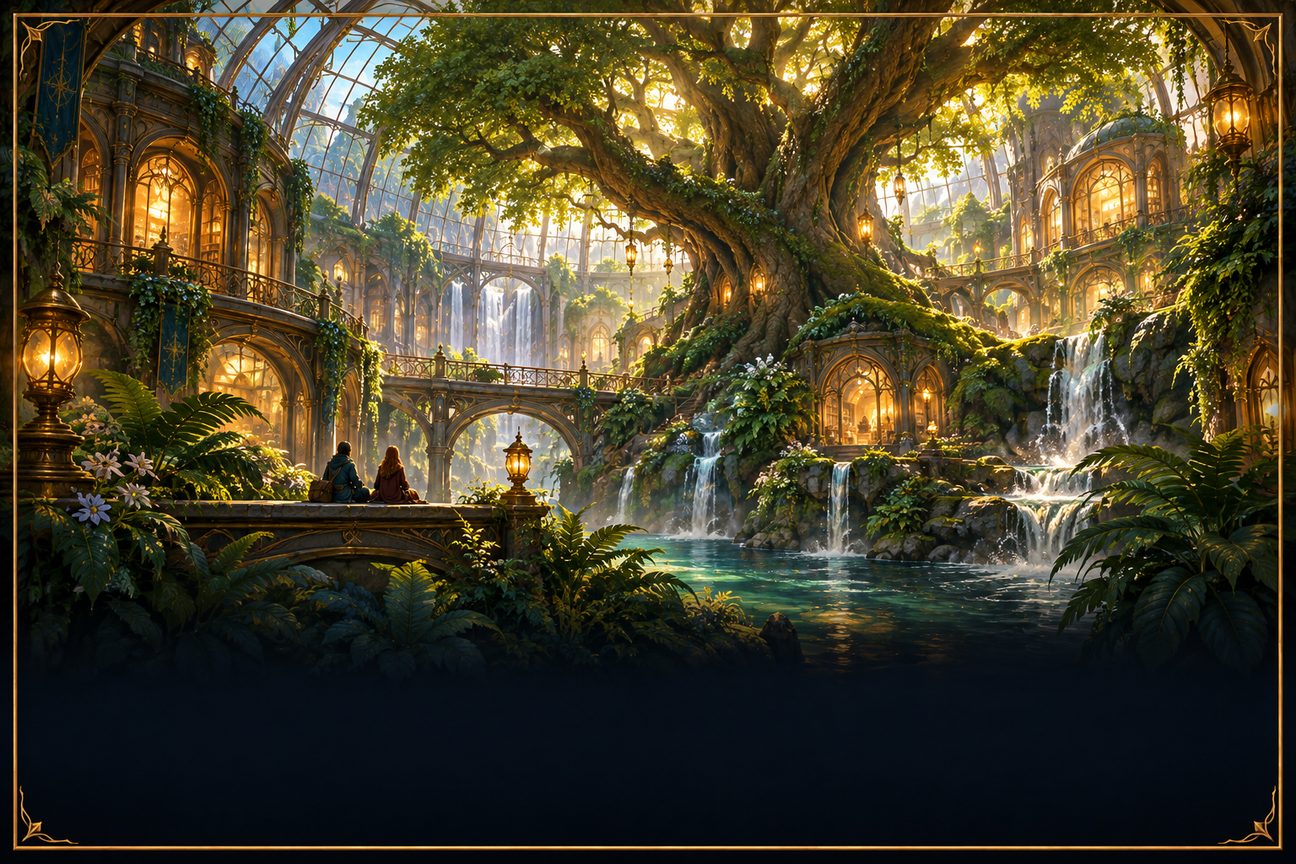
Refugees from dying worlds, the last of a species, gods with no worshippers left. Long ago, Chief Warden Hesper Calloway held a Door open against orders and walked two hundred survivors inside. The wing was built around the people she saved. Old staff still call it the Folly.
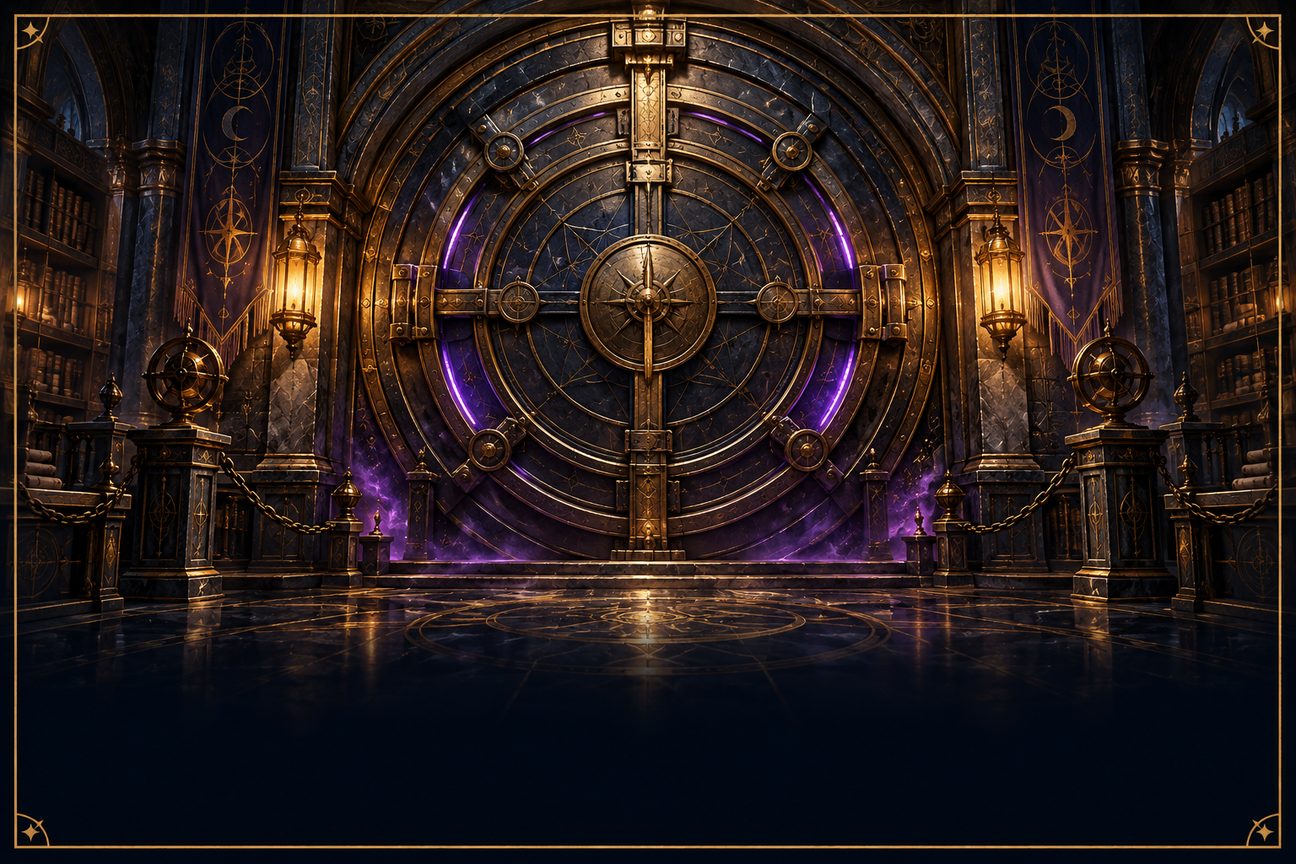
Anything too hazardous to leave loose comes here, under the quiet watch of the Custodes. Below it lie the Closed Stacks: bottomless, sealed, and home to worlds the Library had to close for good.
An endless counter where Librarians leave through their Doors and are checked back in.
A domed hall of glowing tracks, one for each world, showing how much it has been changed.
The heart of the Library, where prophecies surface as text on the walls.
It is always three o'clock in the afternoon there.
Your room slowly reshapes itself to match the world you came from.
Corridors that have come loose. Maps of them expire.
You are a Librarian. Not the quiet kind. This is what the job is, who you answer to, and the five words you need before your first mission.
"The Library keeps. It does not write."
Librarians are readers, not authors. When you change a world's course, its record rewrites itself and the true account is lost for good. Interfering is not forbidden. It is costly, and the choice is always yours.
Founded outside time to hold the book of every world, so that nothing true would ever be lost. It keeps far more than books now.
The job. Everyone also holds a rank and a classification.
The passage into a world. Some open onto other moments in time.
How much your team changed a world.
Brings you home. Bound to you alone. Lose it and you are stranded.
Missions run one to three sessions. You are briefed, you step through, and you come home moments after you left, however long you were gone.
Every Librarian is a Recruit: someone whose home world's record was lost or sealed. There are two ways in. The Found went to sleep in a world and woke at the Returns Desk holding a library card with their name already printed on it. They remember their lives, not the crossing. The Sentenced got in the Library's way, were judged to have value, and chose a library card over a cell. They work off a charge sheet, one mission at a time. Both end up on the same teams.
A Recall Token, a passbook that writes you a cover identity on the far side of every Door, a reading lamp that shows ink only Librarians can see, and a library card that is a badge, a key, and a translator for dead scripts. Doors translate living speech, so you will understand the locals. Understanding their customs is your problem.
Field teams are drawn from several departments. You keep a home department, and its head keeps an eye on you.
How true any of it is, nobody will say.
Every class, ancestry, and community has a place in the Library. These are the options that exist only here.
Make your character the usual way. These six steps fit them into the Library.
Every class fits. Each one also has a Library subclass, further down this page, if you want something made for this setting.
Every ancestry fits; the Library recruits from everywhere. Clanks may have been built in Collections. Or play an Inkborn, someone who walked off a page.
Either the culture of the world you lost, or where you grew up inside the Library:
Your job title in the Library. Any class can hold any classification; these are the natural fits.
How did you come to the Library? Pick one. It carries through to your booking, and your GM builds your first session around it.
Keep any you like and bring the answers to your first session. Pass on any you don’t.
Your sheet lives in Foundry. We build it together on night one.
The handbook has the full rules for every Library subclass, the Inkborn and Sanctuary-born, the Warlock patrons, and the Transformations.
People who walked off the pages of the Records wing. Each began as someone in a book: a hero in a legend, a villain in a history, a nameless guard in a play. They bleed ink, and their source book is still on a shelf somewhere.
Paper-Thin. Fold flat to slip through any gap a sheet of paper could, and drift down like a falling page.
Written Role. Choose the part you were written to play: the Hero, the Rogue, the Mentor, the Monster, the Lover, or the Fool. Play to type and gain Hope. Act against it, and rewrite yourself one choice at a time.
Born in the Calloway Sanctuary to refugees of dead worlds. Your neighbor came from a drowned city, your babysitter was the last of her species, and your schoolteacher used to be a god. You never traveled. The multiverse came to you.
Everyone's Neighbor. Once per session, when you meet a being, people, or custom from any world, say who you grew up next to that was something like it. Your next roll to understand, befriend, or calm them has advantage.
One for every class. Each has a tell: the thing other people notice when you use your gift.
Every world has a book already written. A Librarian trained in Record can read ahead, annotate, erase, or hold a page open. It costs the world something every time.
At character creation a Librarian may swap one of their class’s domains for Record: a Wizard may drop Splendor, a Bard Codex, a Rogue Grace, a Seraph Valor. Everyone else reaches it by multiclassing at level 5.
Domain rule, Clerical: when a Record card marks Impact, you may mark 2 Stress instead and make the edit look like a mistake in the original. Once per scene.
Mark a Stress to place a footnote on a creature or object within Far range. The first ally to make an action roll against or about it this scene adds +1d4. If that roll succeeds, clear the Stress.
Spend a Hope to mark this moment. Once before the scene ends, spend 2 Hope to turn back: one action roll made since then is re-rolled and everything after it is resolved again. The GM gains a Fear; the record noticed.
Add +1d4 to Knowledge rolls to learn about a person, place, or thing. On a success the GM also tells you one true thing its own world keeps hidden. With Hope, ask one yes-or-no question; the answer is honest.
All twenty-one cards, levels 1 to 10, are in the Librarian’s Handbook.
Transformations are earned in play. Each gives you a signature move and a cost you choose how to pay. A character can carry only one.
The Library is full of things willing to bargain. Each asks for a tribute, and once a session, a favor. Your GM may offer others.